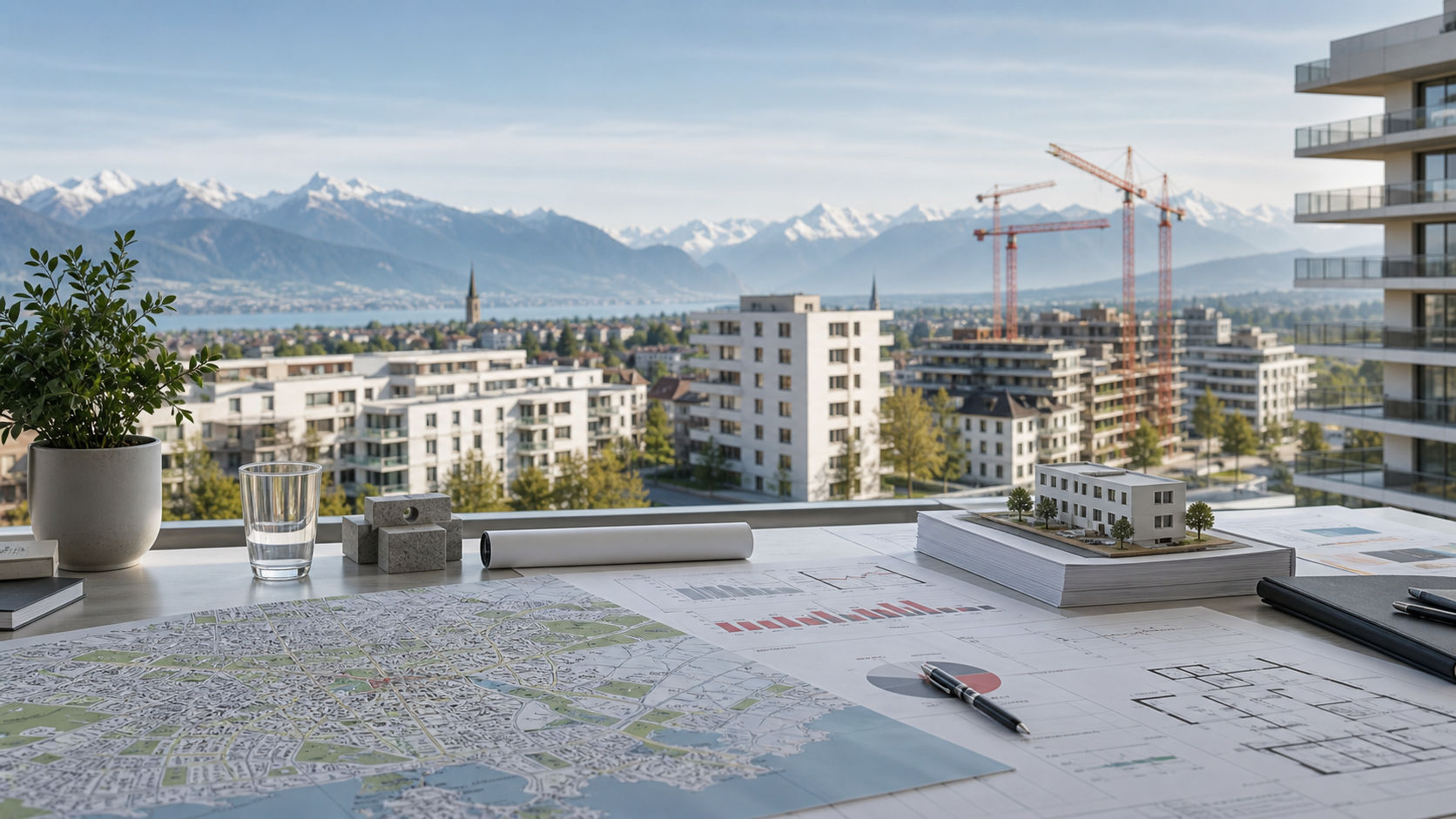
A Market Driven by a Lasting Imbalance
The Swiss real estate market enters 2026 with a very particular dynamic: housing needs remain high, while the production of new residential space remains insufficient in many regions. This tension is not merely cyclical. It takes place in an environment where densification takes time, authorization procedures are becoming more complex, and construction costs demand greater discipline.
In its Swiss Real Estate study for Q2 2026, Raiffeisen highlights that construction activity remains low despite clear signals of shortage. The bank also notes that limited supply, domestic demand, and rising construction costs are expected to put rents under pressure. For investors, the message is clear: scarcity supports the market, but it does not replace thorough analysis.
Why Rents Remain Central to the Issue
Rental housing is one of the segments most sensitive to shortages. When vacancy rates fall, households have fewer alternatives and the market’s capacity to absorb new needs becomes limited. Even though rent growth has temporarily slowed, several indicators show that demand still exceeds supply in many areas.
UBS anticipates a slight further decline in vacancy rates in 2026, with expected increases in offered rents and transaction prices. This outlook does not mean all properties are equal. Well-located, properly maintained housing offered at rents consistent with local purchasing power generally maintains a stronger market depth than properties that are overpriced or poorly positioned.
Low Interest Rates Are Favorable, But Not Enough
The monetary environment remains favorable to real estate. In March 2026, the Swiss National Bank kept its policy rate at 0%, which helps support financing conditions and the appeal of tangible assets. In an environment where defensive investments offer little yield, residential real estate naturally retains an important place in wealth strategies.
However, a low rate does not automatically turn an average project into a good investment. It can improve financing capacity, support valuations, and reduce certain costs, but it does not correct an acquisition price that is too high, a poor location, or a fragile cost structure. Investors must therefore look beyond just the interest rate environment.
The Real Challenge: Selecting the Right Projects
The housing shortage creates a favorable foundation but also intensifies competition for quality assets. In this context, selection becomes crucial. A real estate project must be analyzed through several complementary criteria: the depth of rental demand, the developer’s solidity, equity level, construction costs, safety margin, exit strategy, and price coherence with the local market.
Regions with strong demographic growth, urban centers, well-served areas, and municipalities where supply remains structurally limited can offer interesting prospects. Conversely, some highly sought-after markets may already factor a significant part of this scarcity into prices. This is precisely why a professional approach based on data and comparables remains essential.
Crowdinvesting and Crowdlending: Two Ways to Access the Market
For many investors, directly purchasing Swiss real estate remains difficult due to the required capital, operational management, and lack of access to institutional opportunities. Collective investment models help address some of these constraints.
Real estate crowdinvesting provides access to selected projects by pooling capital from multiple investors. Crowdlending, on the other hand, allows financing a project in the form of a loan, with a different logic regarding returns, duration, and risk. In both cases, the goal is not to replace analysis but to make market access more structured, transparent, and diversified.
What 2026 Teaches Investors
The year 2026 confirms a fundamental trend: Swiss real estate remains supported by robust fundamentals, notably the scarcity of residential supply and strong demand. This situation can create opportunities, especially for well-located and well-structured projects.
But the market is not homogeneous. UBS reminds that the risk of a bubble remains moderate at the national level, while signaling imbalances in certain regions. In other words, Switzerland remains attractive but demands selectivity. To invest methodically, one must prioritize projects with a clear thesis: a real housing need, coherent financing, experienced partners, and sufficient safety margin.
Conclusion
The housing shortage in Switzerland will not disappear in a few months. It results from a deep mismatch between demand, construction constraints, and land availability. For investors, this reality is an important support point but must be approached with caution and professionalism.
In 2026, the best opportunities will not necessarily be the most visible. They will be those combining a relevant location, tangible rental demand, sound financial structure, and controlled execution. It is through this discipline of selection that sustainable real estate value is built.