Faced with increasingly unattractive savings, real estate has appeared for several years as a particularly relevant investment, both for profitability and security. Investing in property has thus become the main concern for those seeking a reliable investment. But entering the real estate market can be done in several ways, and the characteristics of each method are quite specific.
To clarify things, Imvesters breaks down the differences between real estate investment funds and crowdfunding for you.
Profiles that converge
- Accessibility
Traditional real estate investment, such as in a condominium ownership investment, requires significant financial resources. On the other hand, investment funds and crowdfunding are much more accessible since they do not involve acquiring an entire property but rather shares in a collective investment. For the investor, it is therefore possible to enter the real estate market with an accessible investment.
- Purpose of acquisition
When purchasing shares in real estate funds or through real estate crowdfunding, the objective is the same. It is an investment and a diversification of one’s financial portfolio. Indeed, in both cases, it is not possible to use the purchased property as a primary or secondary residence.
- Market knowledge
Investing well in real estate requires some market knowledge. In the case of real estate crowdfunding as well as real estate funds, even a novice can be confident of making a good investment. Indeed, in both cases, the properties acquired are selected by experts based on their potential. Various characteristics are subjectively analyzed to ensure a good return on investment. This approach thus offers the investor more security with fewer administrative procedures.
- Rental risk
Unlike traditional rental investment, which involves finding a reliable tenant and still carries significant rental risk, these two investment methods are very safe. Indeed, the rental risk is spread among the different owners proportionally to their shares. Thus, the risk of receiving no income from the financed property at any given time is lower.
- Property management
In real estate crowdfunding as well as in real estate funds, the property is managed by a management organization. All administrative procedures, maintenance, and daily management are delegated and are not the responsibility of the investors.
These points that make all the difference
- Property ownership
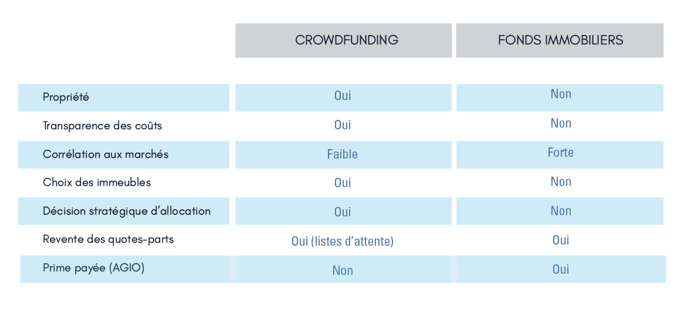
In crowdfunding co-ownership, the principle is to invest together in a building. The building is divided so that each share does not correspond to a specific unit. However, the investor holding the shares is registered as the owner in the land registry. Conversely, in real estate fund investment, it is not about becoming an owner. It is about placing money in a collective fund, which becomes the owner of the properties acquired with the pooled money.
- Choosing your investment
Real estate crowdfunding platforms select properties and then offer them to their investors, who can choose which ones they want to invest in. Investors can thus select the properties they wish to invest in as well as the amount, allowing them to make their strategic allocation. In a real estate fund, once the investor has placed their money, it is invested without their intervention. While they can initially choose their fund based on various criteria and the level of risk they accept, they do not control the actual investments made.
- Participating in decisions
In crowdfunding, since the investor is a co-owner of the building, they participate in decisions made in the common interest. In a real estate fund, the investor is not consulted on decisions related to the acquired properties. The fund management company makes all decisions.
- Transparency
As an owner of a fraction of a building, the real estate crowdfunding investor has access to all information about the property and its operation (management statements, owner statements, costs, fees, reserves, and provisions). In a real estate fund, the investor does not have access to all this information.
- Paid premium (Agio) – market correlation
Unlike investments in real estate funds, crowdfunding is a direct investment and transactions are done "over the counter." This protects against price fluctuations due to this premium and the attractiveness of the real estate market. For example, in 2018, real estate funds experienced negative returns while the underlying real estate continued to appreciate.
What to remember
Real estate crowdfunding and investment funds share many similarities, but their operation ultimately makes them very different. While real estate funds are entirely dematerialized, crowdfunding retains a more tangible approach. Indeed, the investor becomes the owner of a share of a property and participates in decisions. This difference in terms of engagement is fundamental.
Here is a summary table of the differences: