
The Investor's Eternal Dilemma: Return or Safety?
"Don't put all your eggs in one basket" is a saying as well-known as it is important. It applies as much within an asset class as it does to diversifying one's investment portfolio.
In this article, we will clarify the characteristics of the three main asset classes:
Stocks
Stocks are the most well-known and common asset class. Stocks represent ownership shares in a company that are traded on an organized market, such as a stock exchange, or over-the-counter (OTC). During a transaction, supply and demand influence the price and thus the potential for gain or loss.
Stocks are characterized by a significant potential return that some companies can generate, as well as a high level of possible speculation. This class also exhibits the greatest volatility and therefore the highest potential loss.
The risk of volatility is much higher than for other asset classes, as shown by the many stock market crashes experienced over the past 50 years. Having 100% of one's portfolio invested in stocks represents a significant risk. A huge loss can result, as was the case for stock investors during the 2008/2009 financial crisis.
Bonds
A bond is a debt owed by a company. It is a negotiable security representing a loan that pays interest.
The interest rate is known in advance, as is the loan duration (maturity) and the interest payment dates.
Unlike stocks, you do not hold ownership rights. The payment of interest to the bondholder is not conditional on the financial situation of the issuer, such as the financial results of a company, for example.
This asset class is historically less profitable but also less volatile. Given the current level of interest rates, only risky bonds and those in various currencies offer rewarding profiles.
Real Estate
There are two ways to invest in real estate:
- Direct investment
- purchase of an apartment/building directly or via real estate crowdfunding
- Indirect investment
- purchase of a share in a real estate fund
Real estate offers recognized advantages:
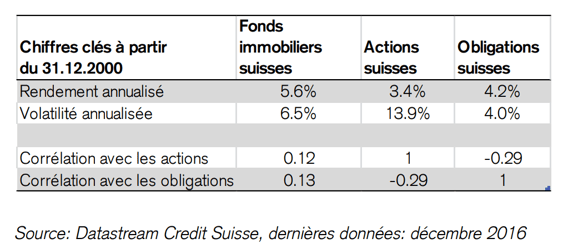
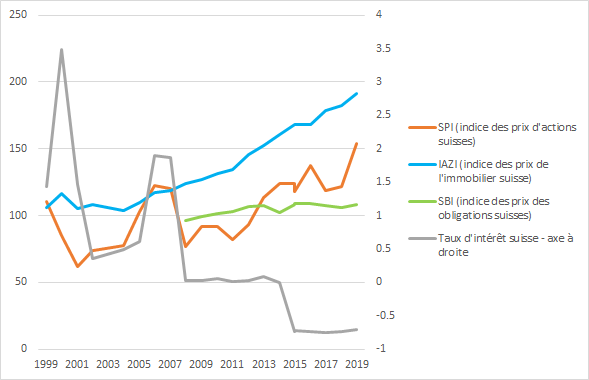
- a risk-adjusted return profile that lies between that of bonds and stocks;
- an almost negligible correlation with bonds and stocks, which is undeniably beneficial for diversifying portfolio risk;
- regular and indexed (rental) income, providing protection against inflation.
2019 Data SIX (Swiss Exchange SA)
Real Estate for Diversification?
Including real estate assets in a portfolio allows for risk diversification while optimizing returns and reducing volatility.
Real estate therefore plays a major role. Various studies show that the ideal weighting of real estate assets in a portfolio is around 15 to 20%. Other studies even suggest a range of 30% to 40% real estate assets depending on the national or international consideration of other financial assets held.
This asset class is among the favorites that savvy investors consider for allocation. The reasons are varied:
- real estate represents a tangible asset;
- the elements involved in a real estate purchase transaction are transparent;
- real estate is based on the real economy (rental income) and is easy to understand;
- investors know the market and its local characteristics because they often already own their home.
Paradoxically, this asset class is often underweighted in portfolios. This is despite its advantages and the fact that it is possible to invest directly or indirectly in many forms (real estate crowdfunding, real estate funds, ETFs, listed real estate companies, etc.).
The weighting of these different asset classes to include in a portfolio will largely depend on the level of risk the investor is willing to accept.
By including real estate in their portfolio, an investor can diversify their risk. However, it should be noted that the securitized real estate market offers fewer advantages since it is correlated with the financial markets where the securities are traded.
It is also important to diversify one's real estate investments.
Example of possible diversification in real estate
Type
- Residential
- Commercial
- Mixed
Geographical location
- French-speaking Switzerland
- German-speaking Switzerland
- City
- Countryside
Key Takeaways
No asset class is without risk. Each has its advantages and disadvantages. Therefore, it is beneficial to hold a range of bonds, stocks, and real estate to reduce the overall risk level of one's portfolio. This provides relative stability in case some markets decline compared to others.
Direct real estate investment has undeniable advantages in diversifying a portfolio. Considering the risk-adjusted return, real estate offers the best characteristics and should be favored when making allocation decisions. The current interest rate and economic environment continue to strongly stimulate the appeal of this asset class.
Before the advent of real estate crowdfunding, it was difficult to invest directly in real estate (large initial capital contributions, strict legal framework, coordination of various stakeholders, reserved for insiders).