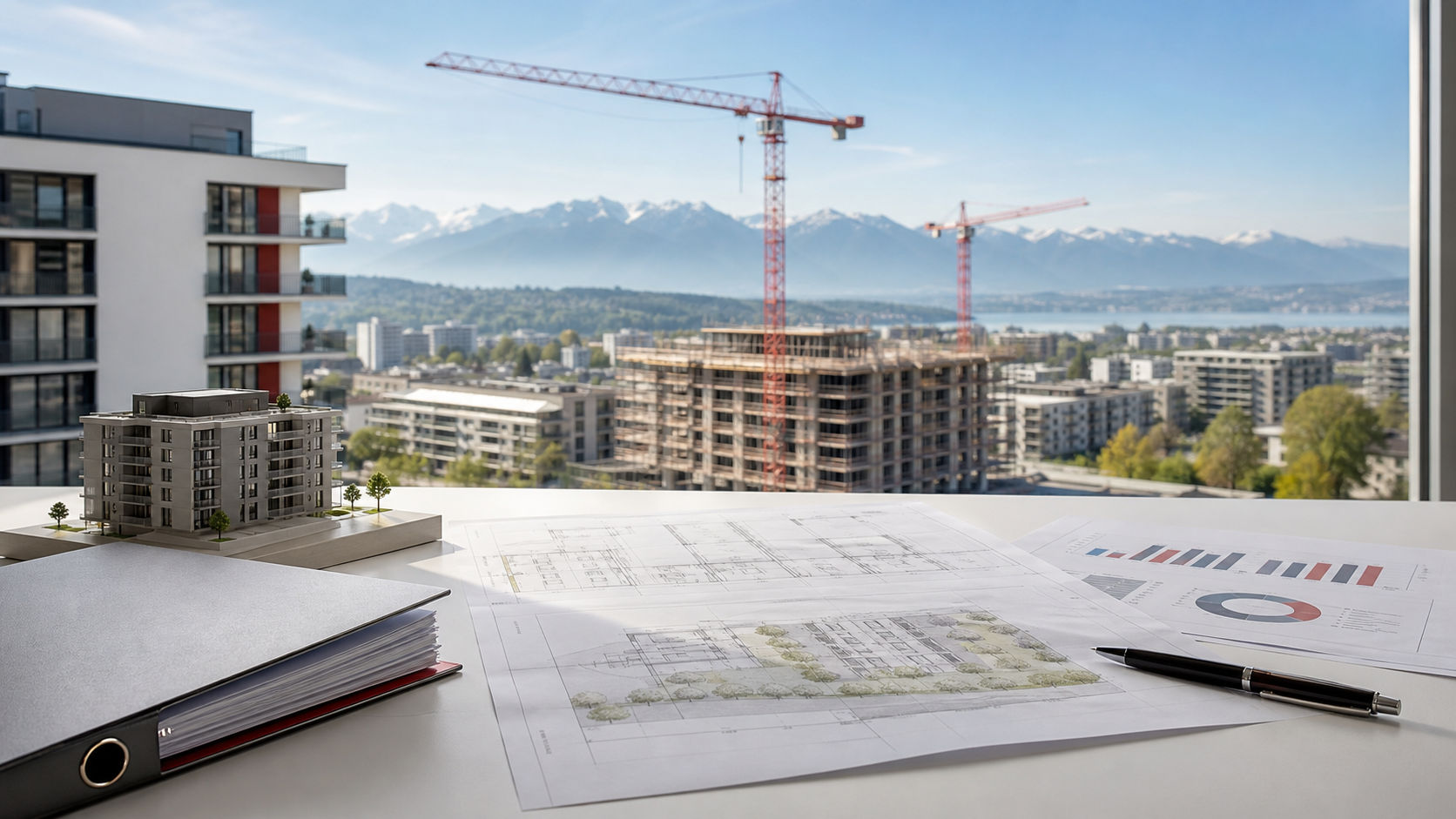
The Housing Crisis Is Changing in Nature
Switzerland is not only lacking housing because demand is increasing. It is lacking housing because supply struggles to keep up. After the rejection of the "No to Switzerland with 10 Million" initiative in the federal vote on June 14, 2026, the debate shifted to a more concrete point: how to build more, faster, and in areas where needs are greatest.
For real estate investors, this development is important. It shows that value is found not only in owning an existing property but also in the ability to bring new housing to market in an environment where procedures, land availability, costs, and opposition slow down production.
Strong Demand, Supply Too Slow
The Swiss residential market remains supported by strong fundamentals: population growth, dynamic employment hubs, professional mobility, preference for housing stability, and strong attractiveness of urban centers. But this demand clashes with limited supply.
Raiffeisen highlights in its Swiss Real Estate study for Q2 2026 that construction remains hindered by several structural factors. Procedures are lengthy, regulations are increasing, available land is scarce, and development costs remain high. The result: even when needs are identified, housing production takes time to materialize.
The Real Bottleneck Is Before Construction Begins
In popular imagination, building faster means speeding up the construction site. In reality, the blockage often starts well before the first crane. Land must be identified, rights secured, permits obtained, oppositions addressed, plans finalized, financing completed, and contractors contracted.
This pre-construction phase has become strategic. A project that already has controlled land, a solid permit, a coherent budget, and an experienced developer holds particular value. It represents not just a future building but time saved in a market that lacks it.
Densification: A Necessary but Complex Solution
Switzerland has little easily mobilizable land. Densification therefore appears as a logical response: building better in already connected areas, close to transport, services, and jobs. But densifying does not simply mean adding floors or replacing houses with apartment buildings.
Densification requires local acceptance, architectural quality, careful nuisance management, adapted infrastructure, and coherent municipal planning. It is a precision exercise. Successful projects are often those that create value for multiple parties: future residents, the municipality, owners, investors, and the territory.
Why Financing Becomes Decisive
In a market where timelines are lengthening and costs remain high, financing is a central lever. Real estate projects need capital capable of supporting development stages, complementing bank financing, and securing execution.
This is where crowdfunding financing models can make sense. Real estate crowdlending allows financing a project in the form of a loan, with a duration, announced return, risk documentation, and a repayment strategy. Crowdinvesting allows greater participation in a value creation logic. In both cases, the goal is to channel capital toward concrete and analyzed operations.
The Housing Crisis as an Investment Topic
The housing crisis is not only a social or political problem. It is also becoming an investment topic because it reveals a lasting tension between residential needs and production capacity. In such a context, assets and projects capable of delivering new well-located housing can benefit from increased interest.
But a simplistic reading must be avoided. A market in shortage does not turn every operation into a good opportunity. Land price, construction cost, administrative timeline, local rental demand, rent levels, taxation, and project exit remain decisive.
What Investors Should Look At
To analyze a residential project in Switzerland, several questions are essential. Is the land truly controlled? Is the permit obtained or still subject to opposition? Does the budget include a sufficient safety margin? Has the developer already delivered comparable projects? Is the local rental market deep? Does the final price remain consistent with purchasing power and rents in the area?
This framework is more important than ever. In an environment where everyone talks about shortage, the difference lies in execution quality. Investors should favor projects where risk is identified, documented, and compensated coherently.
A Possible Role for Imvesters and Imvestlend
In this context, the S2I ecosystem meets two complementary needs. Imvesters allows access to selected real estate projects within a collective investment logic. Imvestlend allows participation in financing real estate projects in the form of loans, with a structured approach to return and risk.
These solutions do not replace professional analysis. They make it more accessible. They allow private investors to expose themselves to concrete projects without having to buy a building alone, negotiate bank financing, or directly manage a real estate operation.
Conclusion
Building faster in Switzerland has become a central issue. The housing crisis will not be resolved solely by political intentions. It will depend on the ability to mobilize land, simplify processes, finance projects, and deliver quality housing in areas where demand is real.
For investors, this situation creates a particularly interesting field of analysis. The best projects will not necessarily be the most visible but those that combine residential need, land control, solid permits, coherent financing, and professional execution. It is in this discipline that the housing crisis can become a responsible investment opportunity.