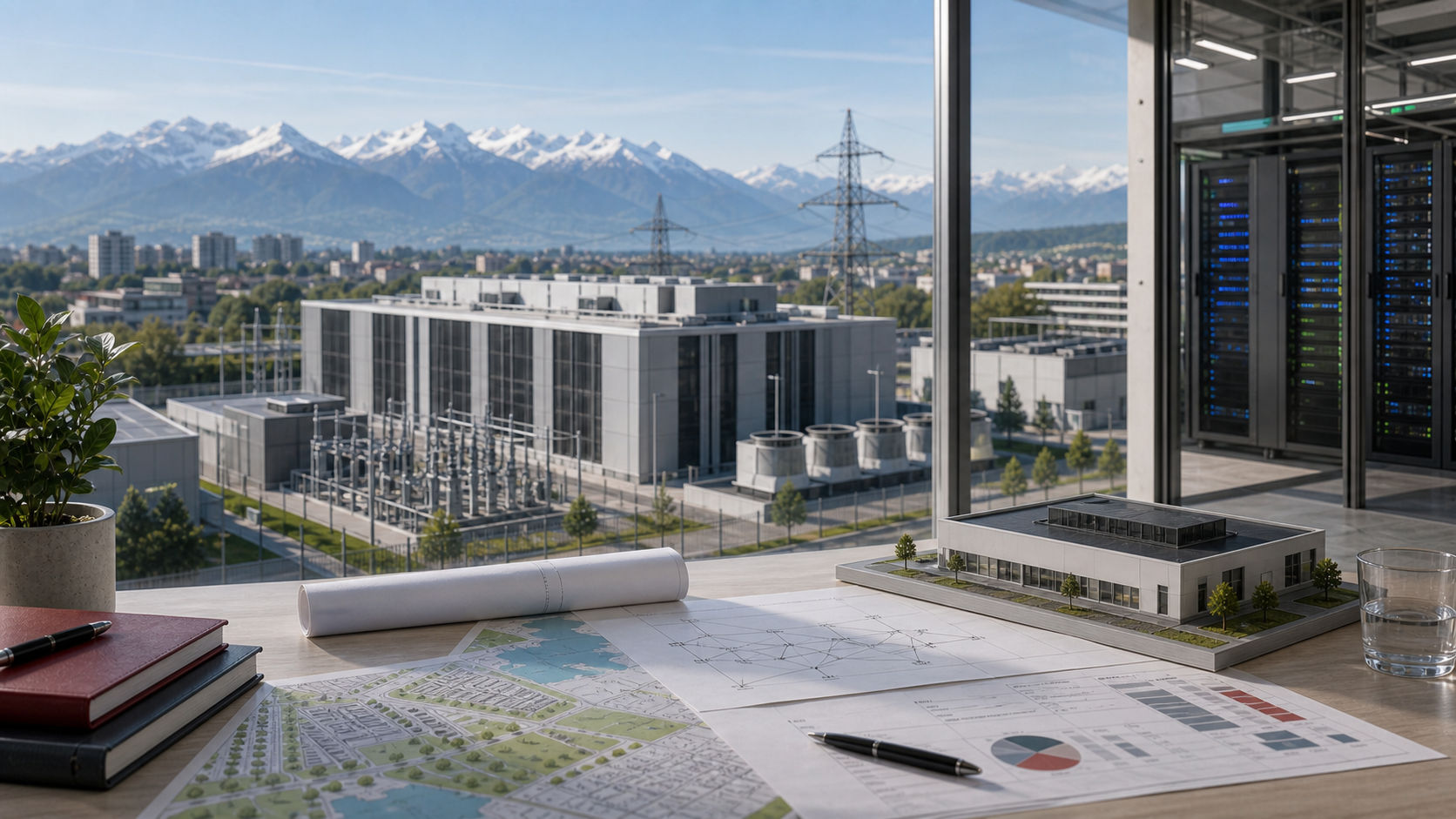
Everyone talks about AI. Very few talk about the square meter behind AI.
Artificial intelligence is often presented as an immaterial revolution. We talk about models, algorithms, cloud, automation, and productivity. But behind every query, every model training, and every digital service, there is a very physical infrastructure.
This infrastructure occupies land, consumes electricity, requires powerful connections, cooling systems, permits, construction timelines, and capital that can wait. In other words, AI is not just a software matter. It is also a matter of real estate, energy, and infrastructure.
The data center, a real estate asset turned strategic
The data center is the building where digital uses live. It houses servers, electrical systems, security devices, cooling installations, and network connections necessary for cloud operation. With the rise of AI, these buildings are becoming larger, more technical, and more demanding.
Demand no longer comes only from data storage or classic web services. It also comes from training and using AI models, which require high computing power. This evolution transforms the data center into a rare real estate asset: it is not enough to have land, you also need access to electricity, network, permits, and a specialized construction chain.
Energy becomes the primary location criterion
In traditional real estate, location often boils down to proximity to transport, jobs, and services. For data centers, location is also measured in available megawatts. The central question is not just where to build, but where it is possible to quickly connect a power-hungry facility.
The International Energy Agency highlights that electricity consumption of data centers is expected to rise sharply with AI. This pressure places electrical grids at the center of investment decisions. A well-located plot but without sufficient connection capacity can lose much of its appeal. Conversely, a site with available energy, connectivity, and permits can become strategic.
Land, permits, and timelines: the less visible reality of AI
The speed of software contrasts with the slowness of real estate. Deploying an application can take a few weeks. Developing a data center can take several years. You need to identify the land, secure rights, obtain permits, organize electrical connections, size the cooling, build the envelope, install equipment, and test site resilience.
This difference in timing creates tension. Computing needs grow very fast, while physical supply takes time to reach the market. This is one reason why institutional investors, infrastructure funds, and specialized real estate players closely watch this segment.
Cooling, a technical and real estate issue
AI increases computing density. The more powerful the servers, the more heat produced. Cooling thus becomes a design, cost, and sustainability challenge. It influences the building’s shape, interior organization, water or energy consumption, and the possibility of recovering some of the heat produced.
In some European markets, heat recovery from data centers is becoming an important topic for district heating networks. This logic clearly illustrates the new frontier of real estate: a technical building is no longer just a container, it can become an integrated element in the local energy ecosystem.
Switzerland and Europe facing a very concrete demand
Switzerland has obvious assets: political stability, quality infrastructure, legal security, a strong presence of international companies, financial institutions, and high digital needs. But it also faces constraints: scarce land, demanding procedures, pressure on the electrical grid, and trade-offs between land uses.
In Europe, major data center markets already experience strong competition for well-connected sites. Market reports from CBRE and JLL regularly highlight that electricity availability, connection timelines, and construction constraints are becoming decisive factors. For investors, this means value shifts toward assets capable of solving these constraints.
Why this topic concerns real estate investors
Data centers are not typical residential or office buildings. They require technical expertise, specialized tenants, long contracts, high investments, and very different risk management. But they show a fundamental trend: real estate is becoming increasingly linked to digital and energy infrastructures.
For an investor, the interest is not necessarily to buy a data center directly. The topic is broader. It invites observing industrial land, business zones, technical buildings, electrical infrastructures, heating networks, logistics assets, and regions capable of hosting intensive digital uses.
Patient capital at the heart of the model
A project linked to digital infrastructures takes time. Costs are high upfront, permits can be lengthy, connections must be planned, and value builds over time. This type of asset thus corresponds more to patient capital than to short-term speculative logic.
This is a useful lesson for real estate in general. Major economic transformations always end up requiring square meters, connections, buildings, and financing. AI is no exception. It accelerates digital, but it also reinforces the need for well-located and well-financed physical assets.
Conclusion
Talking about AI without talking about real estate is to forget the material basis of the digital revolution. Every model relies on servers. Every server relies on a building. Every building relies on land, energy, permits, cooling, and capital.
For investors, the message is clear: opportunities are not only found in companies developing AI, but also in the infrastructures that make it possible. In the coming years, the square meter behind AI could become one of the most concrete topics in real estate investment.