For several years, real estate has appeared as a particularly attractive investment, both in terms of profitability and security. This tangible investment therefore appeals to more and more investors seeking a reliable placement. However, there are different ways to become a property owner, each with its own characteristics.
Between condominium ownership and crowdfunding, there are also significant differences that it is important to know before choosing one or the other. Indeed, while both investment methods allow becoming a registered property owner in the land registry, other aspects differ completely.
Condominium ownership or crowdfunding, two different forms of ownership
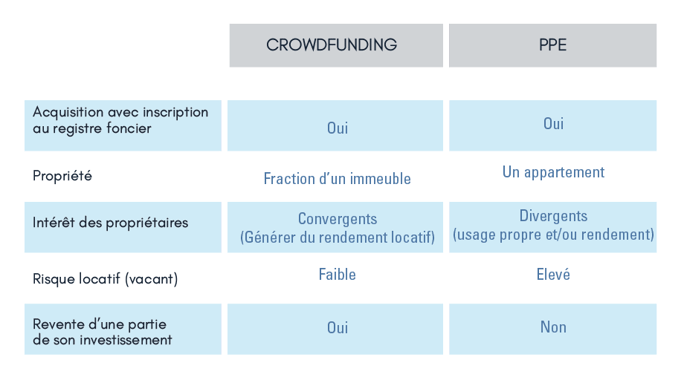
Condominium ownership (PPE) is a particular form of ordinary co-ownership. As such, it grants each owner the right to use, as well as to modify and maintain a portion of a building. In a condominium, this portion, also called a lot, always corresponds to an entire apartment. Thus, the owner can either rent it out or live in it. The value of each condominium unit (lot) relative to the total value of the building is represented by thousandths.
In crowdfunding co-ownership, the building is divided without each share corresponding to a specific apartment. Thus, each owner does not hold an apartment but a fraction of the building (represented by shares). Owners then receive income proportional to their share of the building.
Different financial profiles
Condominium ownership and crowdfunding can meet quite different expectations and needs from investors.
- Accessibility
In terms of accessibility, condominium ownership requires more substantial financial resources since it involves acquiring an entire apartment. Crowdfunding, on the other hand, can be done starting from an investment of 20,000 CHF, which opens the door to many more investors.
- Owners’ aspirations
While a crowdfunding acquisition can only meet an investment need through rental, condominium ownership can meet other expectations. Indeed, the apartment acquired in condominium ownership can be intended for the owner’s residence, a secondary home, or permanent or seasonal rental. Depending on individual motivation, interests can be quite different.
- Rental risk
In the case of a condominium purchase, each renting owner is exposed to rental risk for their own property. Conversely, in a participatory investment, the rental risk is spread among all owners proportionally to each share and over an entire building composed of several apartments. Thus, the risk of receiving no rent at a given time (due to non-payment or vacancy) from a tenant is low.
- Possibility to diversify investments
Purchasing a property in condominium ownership requires significant capital, which reduces the possibilities of diversifying assets by investing in different buildings. Conversely, crowdfunding accessibility with a lower capital in a building composed of several apartments makes it easier to diversify acquisitions (property types, locations, etc.).
Property management adapted to each case
- Property purchase
When new to real estate, people generally act on impulse, whether to live in or rent out. However, to make a profitable investment, especially in rental property, one must have some knowledge of the real estate market and the various factors that can influence a property's value. It is also important to have an expert view of the property itself to avoid unpleasant surprises after purchase. In crowdfunding, platform experts rigorously select properties based on their characteristics. The sole objective is to ensure the profitability of the operation for investors. This represents more security with fewer administrative procedures for the owner.
- Rental management
Finding tenants, generating official documents, ensuring maintenance... In a crowdfunding building, all rental management is handled by a service provider, which reduces the workload for owners. Conversely, in the case of a condominium investment, everything remains the owner's responsibility unless they delegate to a real estate agency.
- Resale of the property
Reselling a complete apartment is rarely a simple operation. Between finding a buyer and the various formalities involved, freeing oneself from the property to recover liquidity takes time. In crowdfunding, waiting lists of future buyers are maintained, ensuring a quick buyer for the share of the building one wishes to sell. Furthermore, the formalities are handled by the crowdfunding platform, making the process much simpler.
Key takeaways
The advantages of investing in crowdfunding are numerous compared to investing in condominium ownership. However, it is important to weigh all the information carefully before considering the pros and cons to be sure to choose the most suitable solution.
Here is a summary table of the differences: